
EXPRESSWAY TO YOUR SKULL (2014)
R E V I E W S

Reviewed by Luke Rodriguez
Posted November 07, 2015
I had a conversation earlier this morning with some fellow Modern Horrors staffers about the conveniences of modern filmmaking. Cameras, microphones, and post production software are all better and more affordable than they have ever been. I'm sure that's why there is no shortage of micro budget horror films these days. A few thousand dollars and a trip to your local Best Buy is really all it takes before you can consider yourself a bonafide filmmaker. Or is it? You can have the greatest gear in the world, but if you have no vision, or style, or passion - none of that really matters. That's what lead me to Expressway to Your Skull. Writer/Director Michael Okum's budgetary constraints are often apparent in his feature film debut, but there's no denying the man's passion or vision.
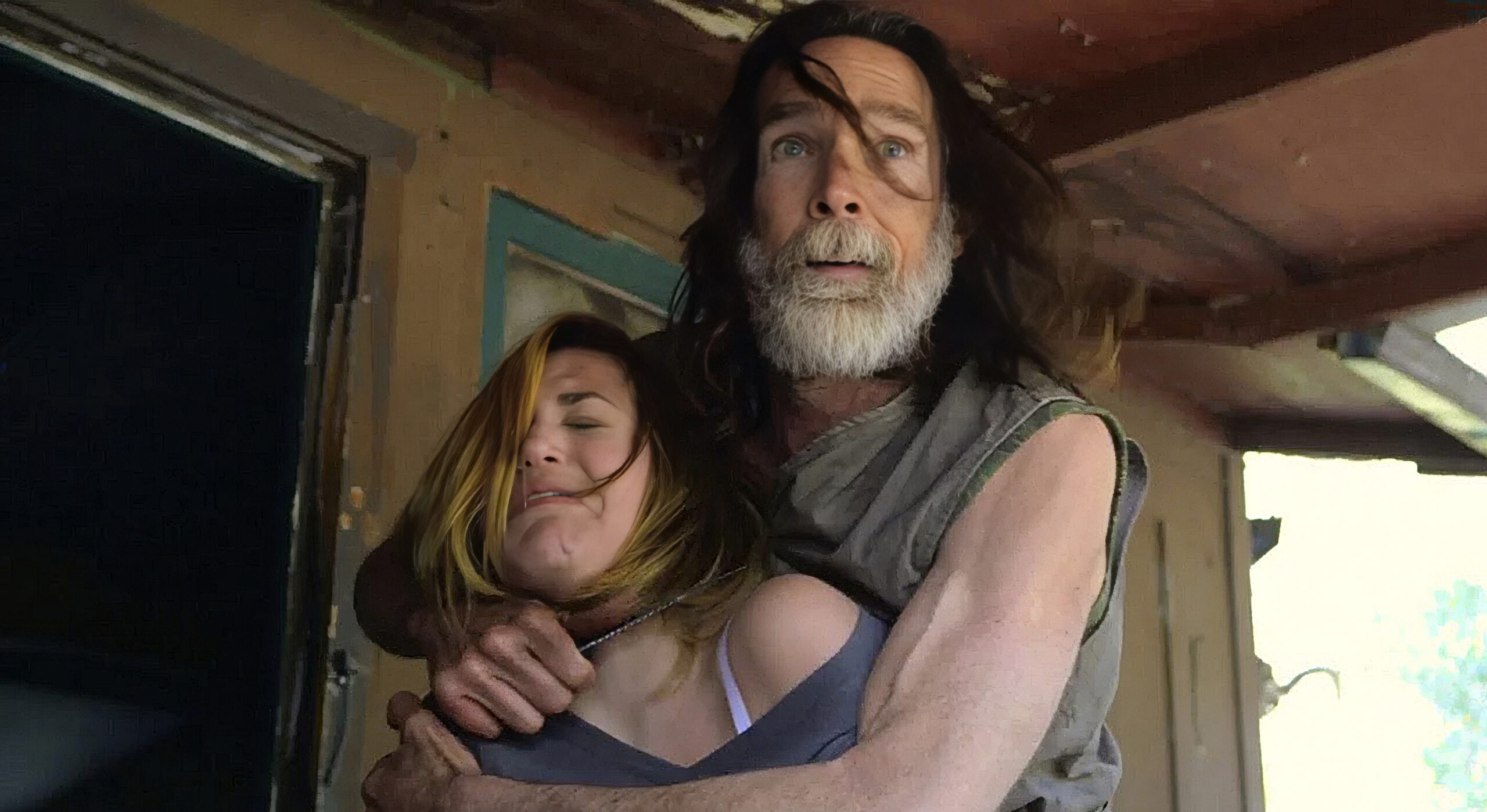
The film follows a young couple that takes an impromptu trip to the forrest to "get back to nature". It's never really made clear why they're going off the grid (other than some vague stuff happening with the boyfriend), but none of that matters. They're there, and they have a backpack full of weed and mushrooms. What could possibly go wrong, right? As you may imagine, shit goes south for our nature-loving couple, but not in the ways you may think. There's no local legend parading around in a goofy mask with a pitchfork, no native american creatures or werwolves stalking them through the trees, and no nearby haunted cemetery leaking paranormal entities into the woods. Just a man.
I've always been a fan of stories where real people do bad shit to other real people. Something about them always seem plausible no matter what backdrop they're placed in front of. That's (mostly) the case in Expressway to Your Skull. A great deal of the film's marketing is directed towards this being a "trippy" film, and I'm not so sure that's the case. Yes, there are some vibrant colored transition animations, and the main characters do go on the hunt for mushrooms once they find themselves disappointed with their own stash - but that's far from the crutch of this film.
In my opinion, any time Expressway to Your Skull begins to lose its footing or direction, Mark Aaron (Charlie) firmly places it back on the track of horrifying realism. Not to discredit the other leads, but this would have been a drastically different experience if not for the performance turned in by Aaron. While the story may plod along from time to time - stick with it - the finale is truly tense. I found myself holding my breath, listening to every sound, and reading the lips of two people in desperate need of help. This one scene colored the lens in which I now see the film through.
This isn't a standard horror movie, at least not by today's standards. Expressway's "subject matter, film style, musical composition, and overall vibe would fit much better in the 1970's; in a smoky video store next to Wes Craven's Last House on the Left or Michael Winner's The Sentinel. If you're into that type of thing, then this one's for you. If not - I say check it out for the final act alone.

Reviewed by Baron Craze
Posted by Duane
At no time does the film screw into wondrous abandonment of senses, it stays rooted, focus on a hidden agenda and goal, but mixes the genres from romance to thriller to dark drama ending in horror. Ed (Paul S. Tracey) and Amy (Lindsay Atwood) meet the intriguing hermit Charlie (Mark Aaron) who already makes his appearance with creative designs to a believable vulnerable Cindy (Katie Royer), who he hope would become his spiritual connection. It is difficult not to provide too many details, as one really needs to discover this gem, especially as the scenes involving Aaron, a feisty man, trained in all elements of the survivability in the woods, firearms and knives, an intriguing mentality and yet at peace with the connection to a more evolve spiritual plane, of strength and love. Charlie has a deep and layered discovery awaiting the viewers, while Tracey and Atwood characters stay very engage with each other and thereby capture the attention of everyone.
Nothing is further from the truth, Charlie's presence adds volumes of depth just from his stature and echoes through his demeanor, measure only by his tone and affliction in stress of words. The story has a masterful touch of generating suspense, producing a film worth of tension filled terrorizing moments striving for the attention from every supporter of the independent market.

Reviewed by MGDSQUAN
October 21, 2015
Here's why I think Expressway to Your Skull will stand out from the crowded "young couple goes into the woods" subgenre of horror. I think, for a reason I can't seem to understand myself, the viewers are going to root for the killer more than the couple he targets for most of the film. There's something very charming about him, a quality that a murderer would want to possess in order to trick unsuspecting victims. The actor, Mark Aaron, is also quite chiseled for a man of his age, so he's deadly in all aspects - guns, knives, wit and strength. He also dabbles in black magic a little, but I don't want to give too much away.

Reviewed by DanielXIII
December 3, 2015
The woods they choose are home to a psychotic black magic practicing psycho named Charlie (Aaron). And that dude is exactly why this flick is a cut above most in the slasher game! Charlie is the most engaging, charismatic character in the film. He's always up to no good, and the supernatural leanings make him even more appealing as he's not just you average "every psycho" with an axe or knife. He pores over arcane texts, sacrifices victims like a high priest of evil, and absolutely commands every scene he is in.

Reviewed by We Are Indie Horror
Soon the couple cross paths with a so-called "hunter" named Charlie (Aaron) who carries his rifle with him into their camp. At first they are only mildly suspicious of him being a threat. But as their plans for a drug-fueled getaway turn sour they find themselves in a fight for their lives against a psychotic survivalist with a diabolical, mind-expanding scheme of his own.
The name of the film comes from a Sonic Youth song with the same title, which absolutely captures the overall feeling of Expressway To Your Skull. Right off the bat we are shown the dangers and horrors of being alone in the woods. Mark Aaron gives a stellar performance as Charlie, the creepy old hermit. His nuanced performance send chills through the spine throughout the entire film. There are few actors who can fully embrace the rolls they are given, and Aaron takes his to the limit in the best way possible.

Reviewed by Saren Suture
November 4, 2015
In fact, the drugs are used more as a clever plot device and not (as I feared would be the case) a replacement for plot. By the time they meet Charlie, our complex villain, it isn't totally ridiculous that they would decide to go off through the woods with him for the promise of killer hallucinogens.
Charlie, played by the very expressive and effective Mark Aaron, offers an understandable villain. Frightening in his blind and arrogant delusions, as well as the obvious trauma and loss that fuels his need for such ludicrous self-inflation of perceived power, he is one human-sized pile of crazy shit that poor Amy and Ed step right into. Again, the hallucinogenic cinematography seeks to enhance the viewer's empathy and show the fear and confusion of characters in a fight or flight situation trying desperately to pierce through the fog of an altered consciousness flight situation trying desperately to pierce through the fog of an altered consciousness.

Reviewed by David J. Sharp
Oct 25, 2015
The performances from all three leads is something to behold. Mark Aaron gives the psycho in the woods character heavier depth than what we are accustomed to, especially when things branch out into more uncharted territory.

Reviewed by Roderick Heath
Posted January 2016
Okum handles his small cast with authority - Aaron in particular has peculiar charisma even when being monstrous. When the gloves finally come off, the film becomes genuinely gripping. Like Wes Craven, Okum scrapes off the skin of civility on his characters to note the primal reflexes lurking under our socialised behaviours, and he takes on a theme other survivalist thriller makers tend to graze with less consideration - reducing the drama to a macho pissing contest where Ed has to essentially face Charlie on the level of caveman fighting for mating rights.

Reviewed by Ambush Bug
Young pretty people Ed and Amy (Paul S. Tracey and Lindsay Atwood) are in love and what to young pretty people do in horror movies? They go camping, of course. But when the mushrooms they packed don't have enough kick to them, they happen across a skuzzy old guy named Charlie (Mark Aaron) who promises them some good drugs if they just come back to his rundown Unibomber shack in the middle of the woods. What could go wrong? The performances here are top notch as well as I would imagine all of the cast, especially the creepy Mark Aaron as Charlie, will go on to do bigger and better things. Okum even is able to make bit parts like the hitchhiker (Katie Royer) stand out.

Reviewed by Jesse
February 03, 2016
The other side of the movie follows Charlie, the maniacal character who lives in a shack in the woods. His story is a little more interesting than the couple's as it involves him kidnapping a hitchhiker and keeping her captive in his home. He's also a little bit insane so it makes him a little bit more entertaining to watch. Mark Aaron did his best to fill the role he was given and stands out as the highlight of Expressway to Your Skull.
About two thirds of the way through Expressway to Your Skull is when the two stories collide in a violent climax. This is easily the best part of the movie as everything that happens matters. It does not involve inconsequential story like the couple in the woods, and it turns Charlie up to eleven in terms of his lunacy. Mark Aaron is able to go as crazy as he wants in the role and makes the final third into an entertaining half hour of the movie.
Posted by Really Awful Movies in Horror
Monday, November 02, 2015
The film is challenging, tense and unnerving. And Mark Aaron as antagonist Charlie is pretty fantastic. It wouldn't be hard to imagine Rob Zombie casting him as Otis if Bill Moseley didn't wish to appear in a sequel to The Devil's Rejects.

Reviewed by Splat EHC4Life!
November 11, 2015
Obviously, from what I have already stated, I dug Charlie as well. Charlie reminded me of this American guy I met last year when he was on holidays with his wife. He was a student of Andy Warhole's in San Francisco back in the day. Naturally he is an artist. Invokes religious and spiritual influences in his art that takes the form of intricate drawings. Delves into government conspiracies such as chem trails and what have you. Each year he would drive out into the desert to create and partake.
Watching Charlie he had the same vibe, which was awesome to see!
Reviewed by Ronny Carlsson
Plot: Packed with a tent and drugs, a young couple go on a camping trip because they need to get away and experience something new. In the woods, they meet the local hunter Charlie - and they're about to learn that what Charlie hunts best is man. Charlie is looking for the perfect woman for his ritual.
Review: The movie is made with a small budget and it looks and feels way better than your average B-horror. Simply put, the movie looks good. It's well shot and you rarely get the feeling that you're watching anything of low quality, which is more than I can say about many movies that come out way. The same goes for the acting, which Mark Aaron makes up for if it ever gets bad. The leads, Paul S. Tracey and Lindsay Atwood are definitely competent, but Mark Aaron has an aura that just describes everything about his character in seconds: he's a deceiving and evil bastard and we know it.
REDLAND (2009)
R E V I E W S
Cinematical
CineVegas Review: Redland
by Eric D. Snider
06-14-2009
We Are Movie Geeks
CineVegas Review:'Redland'
by Kirk
redland
You know well from the opening shots of 'Redland' the direction Asiel Norton is taking you. The less said, the better, even in the film's opening scene, but the starting point of Norton's film, which he wrote and directed, is as memorable and as shocking as anything else found in the film.
Notebook; dailymubi.com
CineVegas 2009 Review ("The Promised Land")
by The Auteurs
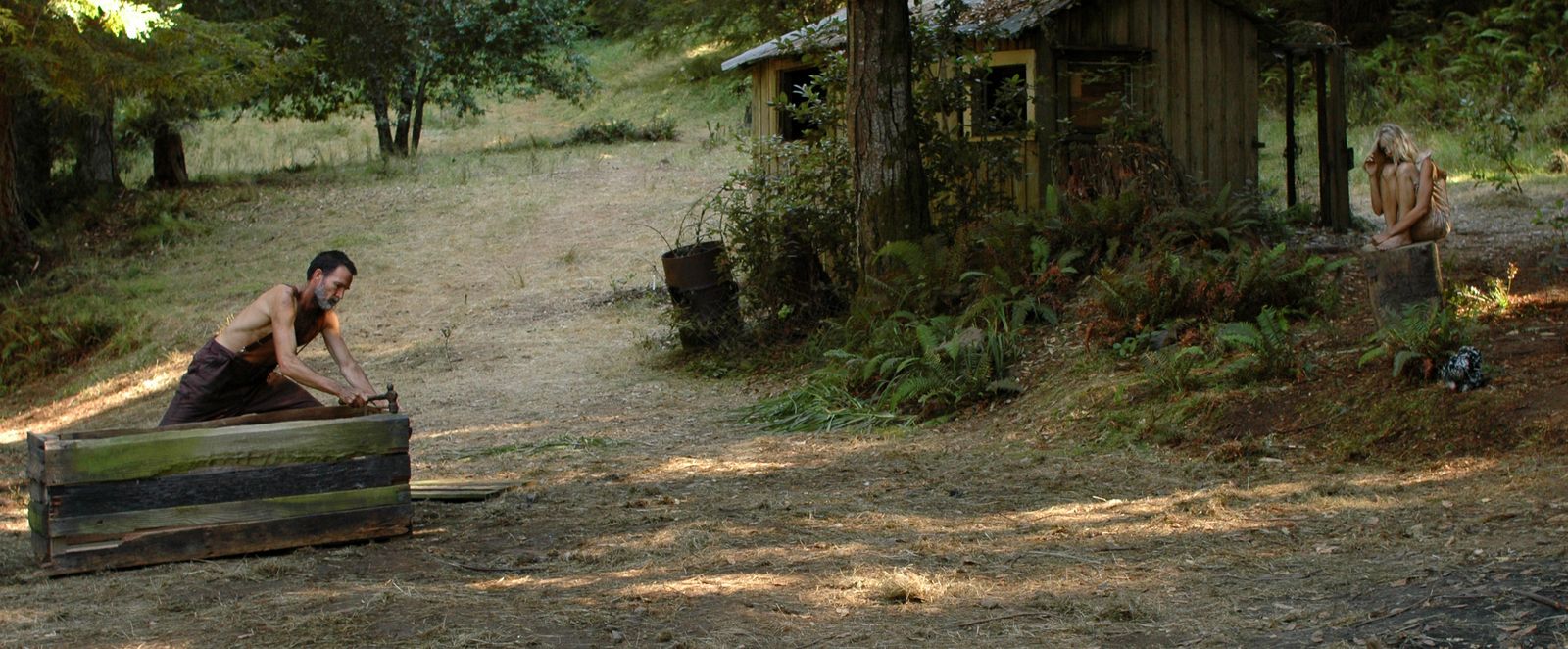
Cheap to fund, digitally shot portraits of everyday life compose the heart and soul of contemporary American independent film. But when a director makes the decision to reject casual naturalism, shoot on film and concentrate on visual beauty, the contrast with typical indie fare is revelatory. Shot on 35mm, Asiel Norton's Redland, which premiered at the 2009 CineVegas Film Festival, is a reminder of how long the spirit of 70's era Malick, Weir, and Altman have been missing from the independent film landscape. Norton says he wanted "the film itself to look alive, like the film was breathing," and Redland does seem like a living entity, resplendent with flaws and blurs, textures and shadows.
CHUD.COM
REVIEW: REDLAND
By Joshua Miller
03.10.2011
The positive spin on Redland - the uncompromising new arthouse drama from first-time director Asiel Norton - would be to call it contemplative. The negative spin would be to call it boring. Regardless of how the film hits you it is undeniable that Redland is slow as fuck. Sadly, I think I easily could have been sucked into the contemplative camp, were it not for Norton's contrived stylistic choices, which made the film feel more pretentious than its story deserved, and worse, made it a chore for me to watch.
Quiet Earth
CineVegas '09: Review of avant-garde western REDLAND
Review by: agentorange
Rating: 7.5 out of 10
If Stan Brakhage tried his hand at narrative filmmaking, I imagine the results would look a lot like Redland - that is to say, the film is a visual and thematic powerhouse. It is a one-of-a-kind, avant-garde film experience where every shot is a painting, every utterance a poem. And, though the film often transgresses its storytelling to meander through the realms of the lyrical (reminding me of Terrence Malick's work at times), the simple story of a family trying to subsist in the wilderness during the "great depression" is made no less of an intoxicating tale of humanity laid bare.
At the heart of the film is a story of two lovers who were thrown together at the worst possible moment in history and now have to deal with the consequences of their ill-timed affair. I had an Aunt who used to say "you can't live on love," and I feel as though that applies here. With everyday being a struggle to just stay alive, love starts to look like a foreign, selfish concern, and something fathers would tend to frown upon at a time of spiritual upheaval. Of course, food in the belly isn't what nourishes the soul. So what does? In Redland, it's equal parts love and revenge. This affair is the catalyst for both in the film. When young Mary-Ann's father finds out she's had an affair, he's hell-bent on finding out who it was. When he heads into the wilderness on a hunting trip he takes the neighbor boy, Charlie Mills, with him. He finds out it was him and makes it his mission to exact revenge. In this sense, Redland feels like it could be a Western. It's earthy and tough, and deals with (and debunks) classic subjects of American mythology like family, honor, religion, selflessness and a host of others, but it's not really. It also looks like a western and once and a while I often found myself wondering why, with so much great attention to detail put into the period costumes, sets and props would they hide them all in such fluid framing. In the end though, the filmmakers juggle all aspects of their piece and proved their artistic intentions are more than sound. Redland is not for everyone. The subject matter is graphic and tough and the visual style is eccentric and intensely lyrical. However, once you give yourself over to it, the film is vastly edifying. The music, the acting, and the writing are all amazing. At times it reminded me of The Proposition, though Redland manages to reach poetic heights that even Hillcoat's film just wasn't willing to climb to. Highly recommended to adventurous viewers.E Film Critic.com
CineVegas 2009 Review: Redland ("The Great Depressive")
5 stars (Awesome)
Reviewed By Charles Tatum
For the first half hour of this film, I seethed with anger. I was bored, drowsy, and pissed. I couldn't stand it. Eventually, I realized I couldn't stand what the film was doing to me, and continued to watch this cinematic dream.
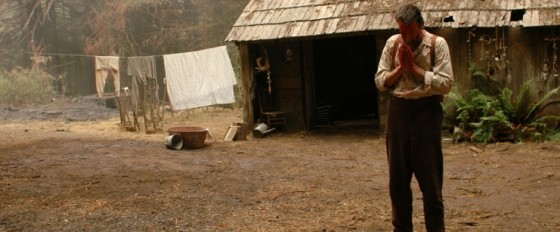
Taking place during the Depression, a backwoods family is starving to death. Mary-Ann (Lucy Adden) has been carrying on an illicit (i.e. unmarried sexual) affair with local boy Charlie (Toben Seymour), meeting him in the woods. Lucy's father (Mark Aaron) catches wind of the situation (seeing Lucy going through some bloody womanly issues during the film's first few minutes), and begins questioning Lucy's brothers, older Job (Sean Thomas) and younger Paul (Kathan Fors) about any men coming around. Out of desperation, Father, Job, and Charlie decide to head out on a long hunt to get food for the family, leaving behind Mary-Ann, Paul, and their mother (Bernadette Murray) to fend for themselves. Tensions rise between both sets of characters as Father eventually suspects Charlie of sleeping with his daughter (and everyone is carrying a hunting rifle), and the family back home resorts to eating a pet chicken, wild berries, and then some possibly poisonous mushrooms. While a plot summary can be straightforward, this film is anything but. The director, Asiel Norton (who co-wrote this with the film's producer, Magdalena Zyzak), set out to shoot a cinematic dream, and succeeded. Thanks in large part to cinematographer Zoran Popovic, this film quickly gets inside your head and shakes things about. I would compare it favorably to the 1970's output of Stanley Kubrick, Ingmar Bergman, or Terrence Malick. Every image looks like a hand-tinted old photograph come to life. The characters are covered in grime and dirt, suffering from starvation and rural boredom (a condition I have witnessed in my home state on many an occasion). The film is frustrating. I didn't like the characters, couldn't quite make sense of things, and felt as isolated and out-of-sorts as the film's family. The sound design and music, both from T.K. Broderick, seemed determined to increase my unease... which they did. Just as in real life, dialogue is understood in snippets. I realized Norton was taking a mere snapshot of life in these creepy woods (which become a character as well), and the viewer may begin questioning the entire hero/villain, good/evil paradigm as they witness these people do what they must to survive. Just like "The Passion of the Christ" or "Saving Private Ryan," this is not a popcorn munching flick, constantly interrupted by trips to the bathroom or cell phone calls. This film doesn't simply ask you "what would you do in this situation?," Norton's direction puts you in the situation shown, where simple answers to stock characters' dilemmas are difficult to come by. There is one sequence near the end of the film, you will know it when you see it, that is so heart breaking and so repulsive at the same time, I had problems watching it, yet Norton keeps your eyes on the screen, witnessing the horror. The cast is so good, I cannot believe they were acting. I kept wondering if every shot of the film was planned, or did Norton and his crew happen upon some impressive footage they were able to utilize during editing? Either way, your eyes will dart all over the screen, trying to take every shaded detail in. "Redland" is difficult. You won't want to go running down to the nearest coffee joint afterward to gab about it, it will stay with you, asking you the very same questions it asks of its characters. In this computer generated day and age, it's a throwback to intelligent film making, and it's brilliant.
"Hammer to Nail Pick of the Week"
at the Filmmaker Magazine blog.
REDLAND
Fiat Lux
by Michael Nordine
Though the influence of its cinematic forebears is readily apparent, nary a film comes to mind whose approach is as singularly visual as Asiel Norton's Redland. Words prove woefully insufficient in conveying its imagistic intensity, but a few descriptions nonetheless come to mind: an aged photograph come to life, key aspects of which are out of focus or otherwise difficult to discern; a visual tone poem saturated in golden light from the seemingly alien sun hovering over it. Complemented by ruminative voiceovers that serve mostly as further reminders of words' inability to express what images so easily can, this light dominates tonally as well as visually. And though they lean into the sun, Norton's characters aren't basking in its glow so much as avoiding the innate darkness contained within: Redland is defined by its light, but it's also painfully aware of its shadow.
Fragmented yet fluid, Norton's film is more a collage of sights, sounds, and (to a much lesser extent) events than it is a linear narrative; early scenes in particular employ an almost constant use of montage in telling the story of a young girl named Mary-Anne hiding a forbidden affair from her family in Depression-era Northern California. Even after the first act, however, the main action of Mary-Anne's brother, father, and lover on a trek through the woods in search of elk is interspersed with flashbacks and cuts back to Mary-Anne at home. Norton presents his characters - which, aside from those just mentioned, consist solely of Mary-Anne's mother and younger brother - more as sketches than portraits. Dialogue is sparse, interactions brief. Given the accompanying (which is to say, deliberately meandering) narrative, it sometimes seems as though Norton is toeing a fine line between style and substance, but a more accurate assessment might be that the film finds its meaning through its evocative presentation. The two are inextricably linked; one cannot exist without the other, and Redland's mise-en-scene is as sun-drenched and ambient as it is because a family so wholly bound to the soil as this one can only flourish when the land itself does. They live off that land, under that sun, and are subject to the beauty and cruelty of both in equal measure. Norton's camera occasionally makes its way indoors and, when it does, the otherwise-golden light takes on a reddish tint. Perhaps this is a mere visual trick - there but not, only holding what significance the viewer projects onto it-but more likely it seems an almost foreboding nod toward Mary-Anne's tenuous relationship with her family. Told "the Devil made her" by her prayer-leading mother (Norton often evokes the Devil in much the same way he reminds us of the darkness: by focusing on its opposite) and most often met by silence from her father, she's a stranger in her own home. Indeed, Mary-Anne is more often seen nestling a chicken under her arms and even bringing it under the covers with her than interacting with her siblings or parents in any meaningful way. (That a birth-related trauma is the film's starting-point and a chicken's primary utility on a farm is its ability to lay eggs lends these moments a special poignancy.) Much like the facility between apparent visuals and latent meaning, Redland presents sex, life, and death (though not necessarily in that order) as a continuous cycle-each flows into the other until they're nearly indistinguishable from one another. If Norton isn't quite elegiac in his approach, it's because the time and place he depicts doesn't particularly seem worth mourning. The land is harsh and largely unfruitful, the family bonds a matter of survival rather than love and affection. In this way, Mary-Anne and her kin are linked to each other just as they are to the earth, the key difference being that the land is indifferent to their presence rather than dependent upon it-they need it, but it certainly doesn't need them. What's more, there's no sign of the goings-on ending anytime soon (as there so often are in films of this sort): these characters are very much in the middle of an era that only hindsight and history tell us isn't as all-encompassing and timeless as Norton so often makes it seem. Michael NordineREDLAND (2009)
R E V I E W S
Cinematical
CineVegas Review: Redland
by Eric D. Snider
06-14-2009
We Are Movie Geeks
CineVegas Review:'Redland'
by Kirk
redland
You know well from the opening shots of 'Redland' the direction Asiel Norton is taking you. The less said, the better, even in the film's opening scene, but the starting point of Norton's film, which he wrote and directed, is as memorable and as shocking as anything else found in the film.
Notebook; dailymubi.com
CineVegas 2009 Review ("The Promised Land")
by The Auteurs
Cheap to fund, digitally shot portraits of everyday life compose the heart and soul of contemporary American independent film. But when a director makes the decision to reject casual naturalism, shoot on film and concentrate on visual beauty, the contrast with typical indie fare is revelatory. Shot on 35mm, Asiel Norton's Redland, which premiered at the 2009 CineVegas Film Festival, is a reminder of how long the spirit of 70's era Malick, Weir, and Altman have been missing from the independent film landscape. Norton says he wanted "the film itself to look alive, like the film was breathing," and Redland does seem like a living entity, resplendent with flaws and blurs, textures and shadows.
CHUD.COM
REVIEW: REDLAND
By Joshua Miller
03.10.2011
The positive spin on Redland - the uncompromising new arthouse drama from first-time director Asiel Norton - would be to call it contemplative. The negative spin would be to call it boring. Regardless of how the film hits you it is undeniable that Redland is slow as fuck. Sadly, I think I easily could have been sucked into the contemplative camp, were it not for Norton's contrived stylistic choices, which made the film feel more pretentious than its story deserved, and worse, made it a chore for me to watch.
Quiet Earth
CineVegas '09: Review of avant-garde western REDLAND
Review by: agentorange
Rating: 7.5 out of 10
If Stan Brakhage tried his hand at narrative filmmaking, I imagine the results would look a lot like Redland - that is to say, the film is a visual and thematic powerhouse. It is a one-of-a-kind, avant-garde film experience where every shot is a painting, every utterance a poem. And, though the film often transgresses its storytelling to meander through the realms of the lyrical (reminding me of Terrence Malick's work at times), the simple story of a family trying to subsist in the wilderness during the "great depression" is made no less of an intoxicating tale of humanity laid bare.
At the heart of the film is a story of two lovers who were thrown together at the worst possible moment in history and now have to deal with the consequences of their ill-timed affair. I had an Aunt who used to say "you can't live on love," and I feel as though that applies here. With everyday being a struggle to just stay alive, love starts to look like a foreign, selfish concern, and something fathers would tend to frown upon at a time of spiritual upheaval. Of course, food in the belly isn't what nourishes the soul. So what does? In Redland, it's equal parts love and revenge. This affair is the catalyst for both in the film. When young Mary-Ann's father finds out she's had an affair, he's hell-bent on finding out who it was. When he heads into the wilderness on a hunting trip he takes the neighbor boy, Charlie Mills, with him. He finds out it was him and makes it his mission to exact revenge. In this sense, Redland feels like it could be a Western. It's earthy and tough, and deals with (and debunks) classic subjects of American mythology like family, honor, religion, selflessness and a host of others, but it's not really. It also looks like a western and once and a while I often found myself wondering why, with so much great attention to detail put into the period costumes, sets and props would they hide them all in such fluid framing. In the end though, the filmmakers juggle all aspects of their piece and proved their artistic intentions are more than sound. Redland is not for everyone. The subject matter is graphic and tough and the visual style is eccentric and intensely lyrical. However, once you give yourself over to it, the film is vastly edifying. The music, the acting, and the writing are all amazing. At times it reminded me of The Proposition, though Redland manages to reach poetic heights that even Hillcoat's film just wasn't willing to climb to. Highly recommended to adventurous viewers.E Film Critic.com
CineVegas 2009 Review: Redland ("The Great Depressive")
5 stars (Awesome)
Reviewed By Charles Tatum
For the first half hour of this film, I seethed with anger. I was bored, drowsy, and pissed. I couldn't stand it. Eventually, I realized I couldn't stand what the film was doing to me, and continued to watch this cinematic dream.
Taking place during the Depression, a backwoods family is starving to death. Mary-Ann (Lucy Adden) has been carrying on an illicit (i.e. unmarried sexual) affair with local boy Charlie (Toben Seymour), meeting him in the woods. Lucy's father (Mark Aaron) catches wind of the situation (seeing Lucy going through some bloody womanly issues during the film's first few minutes), and begins questioning Lucy's brothers, older Job (Sean Thomas) and younger Paul (Kathan Fors) about any men coming around. Out of desperation, Father, Job, and Charlie decide to head out on a long hunt to get food for the family, leaving behind Mary-Ann, Paul, and their mother (Bernadette Murray) to fend for themselves. Tensions rise between both sets of characters as Father eventually suspects Charlie of sleeping with his daughter (and everyone is carrying a hunting rifle), and the family back home resorts to eating a pet chicken, wild berries, and then some possibly poisonous mushrooms. While a plot summary can be straightforward, this film is anything but. The director, Asiel Norton (who co-wrote this with the film's producer, Magdalena Zyzak), set out to shoot a cinematic dream, and succeeded. Thanks in large part to cinematographer Zoran Popovic, this film quickly gets inside your head and shakes things about. I would compare it favorably to the 1970's output of Stanley Kubrick, Ingmar Bergman, or Terrence Malick. Every image looks like a hand-tinted old photograph come to life. The characters are covered in grime and dirt, suffering from starvation and rural boredom (a condition I have witnessed in my home state on many an occasion). The film is frustrating. I didn't like the characters, couldn't quite make sense of things, and felt as isolated and out-of-sorts as the film's family. The sound design and music, both from T.K. Broderick, seemed determined to increase my unease... which they did. Just as in real life, dialogue is understood in snippets. I realized Norton was taking a mere snapshot of life in these creepy woods (which become a character as well), and the viewer may begin questioning the entire hero/villain, good/evil paradigm as they witness these people do what they must to survive. Just like "The Passion of the Christ" or "Saving Private Ryan," this is not a popcorn munching flick, constantly interrupted by trips to the bathroom or cell phone calls. This film doesn't simply ask you "what would you do in this situation?," Norton's direction puts you in the situation shown, where simple answers to stock characters' dilemmas are difficult to come by. There is one sequence near the end of the film, you will know it when you see it, that is so heart breaking and so repulsive at the same time, I had problems watching it, yet Norton keeps your eyes on the screen, witnessing the horror. The cast is so good, I cannot believe they were acting. I kept wondering if every shot of the film was planned, or did Norton and his crew happen upon some impressive footage they were able to utilize during editing? Either way, your eyes will dart all over the screen, trying to take every shaded detail in. "Redland" is difficult. You won't want to go running down to the nearest coffee joint afterward to gab about it, it will stay with you, asking you the very same questions it asks of its characters. In this computer generated day and age, it's a throwback to intelligent film making, and it's brilliant.
"Hammer to Nail Pick of the Week"
at the Filmmaker Magazine blog.
REDLAND
Fiat Lux
by Michael Nordine
Though the influence of its cinematic forebears is readily apparent, nary a film comes to mind whose approach is as singularly visual as Asiel Norton's Redland. Words prove woefully insufficient in conveying its imagistic intensity, but a few descriptions nonetheless come to mind: an aged photograph come to life, key aspects of which are out of focus or otherwise difficult to discern; a visual tone poem saturated in golden light from the seemingly alien sun hovering over it. Complemented by ruminative voiceovers that serve mostly as further reminders of words' inability to express what images so easily can, this light dominates tonally as well as visually. And though they lean into the sun, Norton's characters aren't basking in its glow so much as avoiding the innate darkness contained within: Redland is defined by its light, but it's also painfully aware of its shadow.
Fragmented yet fluid, Norton's film is more a collage of sights, sounds, and (to a much lesser extent) events than it is a linear narrative; early scenes in particular employ an almost constant use of montage in telling the story of a young girl named Mary-Anne hiding a forbidden affair from her family in Depression-era Northern California. Even after the first act, however, the main action of Mary-Anne's brother, father, and lover on a trek through the woods in search of elk is interspersed with flashbacks and cuts back to Mary-Anne at home. Norton presents his characters - which, aside from those just mentioned, consist solely of Mary-Anne's mother and younger brother - more as sketches than portraits. Dialogue is sparse, interactions brief. Given the accompanying (which is to say, deliberately meandering) narrative, it sometimes seems as though Norton is toeing a fine line between style and substance, but a more accurate assessment might be that the film finds its meaning through its evocative presentation. The two are inextricably linked; one cannot exist without the other, and Redland's mise-en-scene is as sun-drenched and ambient as it is because a family so wholly bound to the soil as this one can only flourish when the land itself does. They live off that land, under that sun, and are subject to the beauty and cruelty of both in equal measure. Norton's camera occasionally makes its way indoors and, when it does, the otherwise-golden light takes on a reddish tint. Perhaps this is a mere visual trick - there but not, only holding what significance the viewer projects onto it-but more likely it seems an almost foreboding nod toward Mary-Anne's tenuous relationship with her family. Told "the Devil made her" by her prayer-leading mother (Norton often evokes the Devil in much the same way he reminds us of the darkness: by focusing on its opposite) and most often met by silence from her father, she's a stranger in her own home. Indeed, Mary-Anne is more often seen nestling a chicken under her arms and even bringing it under the covers with her than interacting with her siblings or parents in any meaningful way. (That a birth-related trauma is the film's starting-point and a chicken's primary utility on a farm is its ability to lay eggs lends these moments a special poignancy.) Much like the facility between apparent visuals and latent meaning, Redland presents sex, life, and death (though not necessarily in that order) as a continuous cycle-each flows into the other until they're nearly indistinguishable from one another. If Norton isn't quite elegiac in his approach, it's because the time and place he depicts doesn't particularly seem worth mourning. The land is harsh and largely unfruitful, the family bonds a matter of survival rather than love and affection. In this way, Mary-Anne and her kin are linked to each other just as they are to the earth, the key difference being that the land is indifferent to their presence rather than dependent upon it-they need it, but it certainly doesn't need them. What's more, there's no sign of the goings-on ending anytime soon (as there so often are in films of this sort): these characters are very much in the middle of an era that only hindsight and history tell us isn't as all-encompassing and timeless as Norton so often makes it seem. Michael NordineUNBROKEN CIRCLES (2009)

R E V I E W S
March 2nd, 2009
The Odyssey Theatre
Backstage West
By Madeleine Shaner
HE WHO ENDURES (2007)
R E V I E W S
Stella Adler Theatre
Wassup in Hollyhood
by Rych McCain
THE CRUCIBLE (2004)
R E V I E W S
Morgan Wixson Theatre
Palisadian Post
Theatre Review: "The Crucible" Resonates Today
By Alyson Sena
Palisadiall-Post Staff Writer
The Santa Monica Theatre Guild's poignant production of "The Crucible" asks viewers to examine the paranoia and intolerance that can break down a society. What must one man sacrifice in order to stand up for his beliefs and against injustice? Directed by William Wilday and produced by Thomas DeBacker, the show runs through November 20 at the Morgan-Wixson Theatre in Santa Monica.
The strict Puritan values of order, discipline, unity and conformity are embodied in Salem's ministers and judges, who rule the small community under a tight moral and religious code, "There is either obedience or the church will burn," says Reverend Samuel Parris (Donald Heath), who discovers his niece Abigail Williams (Bevin Hamilton) and daughter Betty (Moriya Shachar) dancing wildly in the forest with black servant Tituba (Valeri Braun).
When Betty falls ill from the shock of seeing her father jump from the bushes, suspicions of the girls' actions and fear of "unnatural causes" cause the leaders to tighten their grip. An intense period of questioning follows, under which Tituba and the girls buckle from fear of punishment and feed off of one another's accusations of witchcraft.
Abigail becomes the leader of the pack, driven by ulterior motives to continue an affair with farmer John Proctor (Thomas DeBacker) and take revenge on his wife, Elizabeth (Candice Balen), for discharging her as the family's servant. In the role of Abigail, Hamilton is moving and convincing as she feigns being possessed by the devil, demands the other girls" loyalty and compliance, and flirts with Proctor.
DeBacker gives a commanding performance as Proctor, who represents the Puritan belief in hard work but rejects the culture's rigid laws, which leave no room for human error.
Failing to name all 10 Commandments when asked is a sin in this society. But when Proctor's wife reminds him of the one he left out: adultery-we understand that Proctor's real struggle is with his conscience and what he calls "the single error of my life."
Proctor is a characteristic Arthur Miller character in his tragic struggle. He earns the respect of his wife and neighbors when he ultimately refuses to sign a false confession that he compacted with the Devil. "I have given you my soul; leave me my name!" he exclaims at the production's climax.
The sexual repression of the people of Salem is manifest in Abigail's seemingly uncontrolled groping of the air and her body, and in her accusation of Tituba: "Sometimes I wake and find myself standing in the open doorway and not a stitch on my body! I always hear her laughing in my sleep. I hear her singing her Barbados songs and tempting me with--"
In this society's extremist mentality, even a woman reading a book becomes anathema, as Giles Corey (Dan Adams) learns when his own curiosity about his wife's book reading results in her arrest. Corey is one of the few who stand their ground against the wrath of Deputy-Governor Danforth (Christian Morgan), the fierce judge who arrives to purge the Puritan society of evil. With ease, Morgan delivers his lines and plays the terrifying character who abuses his power in order to protect his pride.
Pity and compassion in the rigid society are scarce, but do exist in the Reverend John Hale (Mark Aaron), who is called upon to lead the girls back to God's grace. In devoted attempts to help the people, Hale reveals his own inner conflict between society's moral and religious code and an individual's right to justice. Aaron is well cast in this emotionally demanding role that bares open his character's struggle to maintain some degree of faith in the eye of injustice.
SOMETHING WICKED
THIS WAY COMES (2003)
R E V I E W S
The Edgemar Center for the Arts
by Jose Ruiz
Director Alan Neal Hubbs starts out with an austere set using clever projections of houses and other elements of the play, and eventually the stage becomes a full carnival complete with house of mirrors and even a ghostly carousel.
With a cast of dozens, led by Grady Hunt and J. Skylar Testa who are great playing the youths, Jay Gerber gives a compelling performance as the father whose son's love inspires unexpected courage. Mark Aaron is excellent as villain Dark, with frightening steely stares and hissing whispers, and David Polcyn gives Cooger the right blend to be the requisite villainous sidekick, not totally bright, not totally evil, but totally loyal.
Other actors include Cris Capen, Bruno Marcotulli, Priscilla Allen, Robin Poley, Laura Raynor, Gudrun Giddings, Kacey Camp, Darian Weiss, Howard D. W. Yates, Carlie Westerman, Rachel Lane, Felisa Kazen, Douglas R. Clayton, and Patrick Stone.
Of all the imaginative sets by John E. Blankenchip, the best is the carousel, where actors use distorted stylized animal masks as they circle the carousel's diameter with an almost reluctant gait. It's as if some force was compelling them to circle against their will. The carousel is the focal point of the story, providing a double metaphor that clearly exemplifies that the greatest wish of eternal youth for some can become the worst fear of others.
Source: www.reviewplays.com